





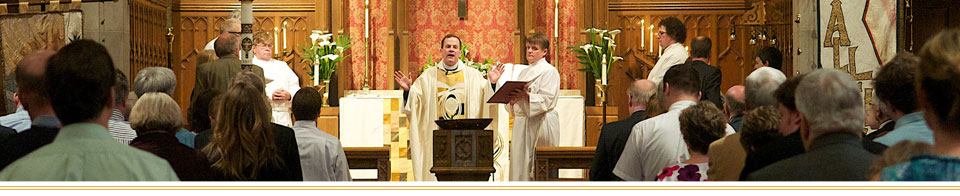
Wednesday, March 9, 2011: Ash Wednesday
Holy Eucharist with the Imposition of Ashes
Noon and 7:00 p.m.
Sunday, March 20, 2011: First Sunday in Lent
Holy Eucharist at 8:00 & 10:45 a.m.
Sunday, March 20, 2011: First Sunday in Lent
Lent Procession Service: A Service of Lessons and Carols for Lent
4:00 p.m.
Monday, March 7, 2011

Tuesday, March 1, 2011
This Week's Liturgies
Sunday, March 6, 2011
The Transfiguration of Our Lord
Holy Eucharist at 8:00 & 10:45 a.m.
The Transfiguration of Our Lord
Holy Eucharist at 8:00 & 10:45 a.m.
The Olive Branch: 2-28-11
Accent on Worship
An Angel From God
As many of you know, I was in Houston last week leading a hymn festival. I was put up in a downtown hotel – a lovely place two short blocks from a small concentration of places to eat. It was a great location to stay.
Coming back from dinner on Saturday evening, a man approached me and asked if I had a quarter. I stopped, and pulled out my wallet and gave him all the smaller bills I had – around four one-dollar bills. No questions. I told him to take care, and left. He thanked me. The next morning, I was returning to the hotel from a coffee shop and the same man again approached me and asked for a quarter. I looked at him and said, “You hit me up last night! I did my part.” and walked on.
Did my part??!! Immediately I realized what a ridiculous thing that was to say. And what did that mean? To him? To me? To God? To hunger and poverty in general? I give four bucks away and think I’ve fixed it all? That this is all that is required to do “my part”? Wow.
The truth: I had many 20s in my wallet from a nearby cash machine. And when they would run out, I have a little piece of plastic that I stick into a machine just about anywhere in the world, and it spits more 20s out at me anytime I need them. I could have given him all of my 20s without feeling anything: with plenty to even get through the day. This man only asked for a quarter.
Then came the Gospel lesson this past Sunday: “Consider the lilies … do not worry about tomorrow.” It helped me remember that probably the main reason we don’t let go and give more is our fear of not having enough. Fear about tomorrow. What we’re going to eat, what we’re going to wear. And we fear this in spite of the fact that we are surrounded by access to an embarrassing quantity of options for both. When I hear of churches asking the question “Should we (fill in the blank – like buy a pipe organ) or feed the poor”? As if the rhetorical and obvious self-righteous answer is the latter. The truth is both could be afforded. Both. In abundance. God would be served by doing both, but also by our letting go of the riches in the first place.
I think God sent this angel to me to help me remember to let go of this worry. To know that 20s could be gone from my wallet and I still have what I need. Why not let go of them when asked? Why does it take someone asking?
About a half hour after my second encounter with the man, I was standing outside the hotel waiting for my ride to the church. A couple approached me and told a relatively long story about needing bus fare to get somewhere. I asked how much the bus fare was that they needed. Then realized it didn’t matter. I pulled out my wallet and gave them a 20. They walked away grateful. The hotel concierge asked if he should call the police. “Naw – I just needed to let go of a 20.”
Here’s the question bugging me: now why not all the 20s I had? May we find ways to let go of this terrible fear we have.
These experiences reminded me that I’m ready for Lent. To again learn of my true needs. To recommit. To repent.
- Cantor David Cherwien
Sunday’s Adult Education
9:30 a.m. in the Chapel Lounge
Sunday, March 6: “Interpreting the Psalms,” led by Hamline University Professor Earl Schwartz (see information elsewhere in this issue of The Olive Branch.
Ash Wednesday: March 9, 2011
Holy Eucharist with the Imposition of Ashes
Noon and 7:00 p.m.
Shrove Tuesday Supper
Come and celebrate Shrove Tuesday with the youth of Mount Olive, preparing for the fast with a feast on Tuesday, March 8, 2011, at 6:00 pm.
Tickets prices are $5/adults and $3/kids in advance ($7 and $5, respectively, at the door).
Thrivent Financial Thrivent Choice Dollars
If you are a member of Thrivent Financial, you may be eligible for Thrivent Choice dollars and can designate them to Mount Olive. We are now listed as one of their
preferred organizations. It’s simple to do. You can direct Choice Dollars online or call 800-THRIVENT (800-847-4836) and state “Thrivent Choice.” Several Mount Olive members have already participated, and this is a wonderful way to give extra funds to the church budget and is one of the benefits Thrivent offers to members.
Field Trip to the Minneapolis Institute of Arts
A special event is planned for Sunday, March 20, and you're invited to participate.
There is a fascinating exhibit at the Minneapolis Institute of Arts, entitled The Mourners: Tomb Sculptures from the Court of Burgundy. These small sculptures have adorned a French royal tomb since the late 14th century. They depict mourners of all walks of life expressing their grief in various ways. This is a fitting exercise for Lent, as we are continually reminded that we are dust, and to dust we will return.
We will depart from Mount Olive after the late worship service, stop for lunch and then proceed to the MIA. There we will see the Mourners exhibit, and then be joined by a docent for a private tour of art that express spirituality in some form. Cost of lunch is on your own, and admission to the MIA is free. If you are interested, please RSVP to the church office (612.827.5919 or welcome@mountolivechurch.org) or contact Lora Dundek (lhdundek@usfamily.net).
For more information on the exhibit, check out the MIA's website at http://www.artsmia.org. Please join us!
Book Discussion Group
For its meeting on March 12, the Book Discussion Group will read The River of Doubt, by Candice Millard. And for the April 9 meeting, they will read and discuss the poem Gilgamesh.
This group meets on the second Saturday of each month at 10 a.m. All readers are welcome!
Professor Earl Schwartz to Lead Adult Forum This Sunday
Earl Schwartz has been teaching at Hamline University's Religion Department since 1993, has been the Director of Hamline's Social Justice Program since 1999, and was also an adjunct member of Hamline University's Law faculty from 1994-97.
In 1983, he published Moral Education: A Practical Guide for Jewish Teachers, he co-authored (with Rabbi Barry Cryton) When Life is in the Balance: Life and Death Decisions in Light of Jewish Tradition, in 1986, and also published Who Renews Creation in 1993, as well as numerous articles on Jewish thought and history.
In 1999, Earl Schwartz was named an Exemplary Professor of the Year and in 2003 was named Faculty Member of the Year. He serves on the Editorial Board of the Journal of Law and Religion.
March is Minnesota FoodShare Month
March is Minnesota FoodShare Month, an annual month-long effort sponsored by the Greater Minnesota Council of churches to help re-stock area food shelves. This work is and supported by congregations, and other religious and civic associations throughout Minnesota, and Mount Olive has participated every year since it began in 1982.
The need this year is as great as ever, so we encourage you to be extra generous with your donations of money or non-perishable food items for our local food shelf during the month of March. This drive fills the shelves of 300 food shelves across the state of Minnesota.
Fifty percent of all food shelf recipients are children, twenty percent of all adult recipients are elderly, and sixty percent of all adults who use the food shelves are the working poor.
We especially encourage you to consider giving a financial contribution via your blue envelopes instead of groceries, noting that it is for the food shelf. For every ten dollars donated, food shelf workers can buy $40 worth of food through various purchasing resources not available to the general public. So monetary donations go much fartherHowever, if you enjoy shopping for food to give in this way, please do so and place your food donations in the cart in the cloak room.
Two Bread for the World Events
Those interested in eliminating the causes of global poverty will want to mark their calendars for two up-coming BFW events.
On Saturday, April 2, the President of Bread for the World, David Beckmann, will be the keynote speaker for a Global Poverty Summit to be held at Christ Church International, 3015 13th Ave. S., Minneapolis from 9:00 a.m. to 3:00 p.m. You may pick up a brochure with more information about this at the Neighborhood Ministries bulletin board. To RSVP for the event, email breadmn@bread.org or call 612-871-9084.
The Bread for the World Offering of Letters will be the Adult Forum feature on April 17, Palm Sunday. The bill to be proposed in Congress will address foreign assistance. The objectives are to streamline it and make it more efficient, to focus on reducing poverty, to have clearer accountability on how funds are spent and the results, and to meet the needs of local people. A presentation will be given and everyone will be invited to write to their congress persons in Washington after the presentation. Everything you need to do this will be made available including a sample letter with all the bullet points. This is a powerful way to help the poor and it won't cost you a cent.
“Lord, Teach Us to Pray” - Midweek Lent at Mount Olive
The forty days of Lent begin on Ash Wednesday, Mar. 9, with Eucharist and the Imposition of Ashes at noon and 7:00 p.m. (Celebrate Shrove Tuesday at Mount Olive on Mar. 8 – see separate article).
For the other Wednesday Lenten services this year we will focus on the Lord’s Prayer, and what our Lord Jesus teaches us about our prayer life with God. The midweek schedule, beginning on Wednesday, Mar. 16, is Eucharist at 12:00 noon, followed by a soup lunch at 1:00 p.m. In the evening, there will be a soup supper at 6:00 p.m., and Evening Prayer at 7:00 p.m. The preaching at the noon Eucharist will be reflections on the Lord’s Prayer, and the same meditation will be shared during the evening soup supper, with opportunity for further conversation at the meal.
Church Library News
I am pleased to be able to share some positive news regarding the restoration of the Louise Schroedel Memorial Library, which was dismantled and packed away in storage in September 2009 in order to make way for the two new restrooms which now occupy that same space. During the construction activities of 2010 and particularly the moving of the church office and the staff offices from the west wall to the north wall, a space at the very end of that north corridor was allocated for the use of the Louise Schroedel Memorial Library, when it could again be restored.
Several work sessions have now gone forward unloading the many, many boxes of books and other items that came from the old library. It is likely that we will need several more weeks before we are ready to open the door restoring this library ministry to its former usefulness. Special thanks goes to David Molvik and Mark Pipkorn who have helped immensely to get the old library shelving units in place and re-attached to the walls, where that was needed; to Mark Henning for the installation of the new countertop laminate; to William Pratley, our new Sexton, who helped to place the shelves in the proper shelving units and clear away used boxes as they are emptied; and to Mabel Jackson, who has worked with me to refill shelves with books and other media as the restoration plan has unfolded. Another specific word of thanks to David Molvik who has made countless trips up and down stairs to keep the boxes of books available to us in a proper sequence for unloading. As you would assume, all are volunteers!
I would like to share something that we noticed as boxes of classic children's books (or even a book series) were unloaded and we came across some that were more dog-eared or well worn, however, after looking at those same check-out cards (some from the 1970's well into the 1990's and beyond) along with many familiar family names, it usually revealed that at least 30-40 or more children had delighted in reading those same books. It was then my feelings changed to gratitude that our church library had helped to extend God's love and witness touching each child, as well as many other books and special media affecting entire families in one way or another. "To God be the glory!"
It is well to remember that even though this library ministry opened in November 1965, little remains in our collection from that time and the library has evolved over the years, having been weeded and updated several times as it grew. Down the line and as time, funds and a re-evaluation permit, more weeding will be done to provide a useful and more current look to our collection, not only to books but also to videos, which are the VHS type we had at the time the library was dismantled. While we were aware that Christian digital videos were becoming more and more available, we didn't have the funds to make the change happen at that time.
Kudos also to Dan Burow, who loaned us the larger part of our CD collection, also now available to the congregation on a check-out basis. This collection ranges from great choral works, as well as recordings of our own great choirs, hymn sings, and other pieces that are traditionally classical or semi-classical.
In the meantime, we hope you are taking advantage of the wide variety of books available in the more casual setting of the Courtyard Mini-Library. Watch for more updates regarding the restoration of the Louise Schroedel Memorial Library.
- Leanna Kloempken
A Menu of Brunches
As many of you know, there is a flyer in the narthex at church which includes suggested local venues for brunch after church. We will be updating this listing in the near future! If you know of a restaurant to suggest for this listing, please send the information to Susan Cherwien at scherwien@aol.com, or speak to her at church.
Monday, February 28, 2011
Sermon from February 27, 2011: Eighth Sunday after Epiphany, A
“On God’s Hands”
Pr. Joseph G. Crippen (Text: Matthew 6:24-34; Isaiah 49:8-16a; Psalm 131)
Sisters and brothers, grace to you, and peace in the name of the Father, and of the + Son, and of the Holy Spirit. Amen
There’s a beautiful moment in John’s Gospel as he tells the story of Jesus’ night of betrayal. Jesus has washed the disciples’ feet, and has given them the commandment to love, even as he tells them he is going away. Peter promises to stay with him always and is immediately told by Jesus that he will deny Jesus three times before the rooster crows the next morning. But right away Jesus follows those hard words with these words to Peter, and the other disciples: “Do not let your hearts be troubled. Believe in God, believe also in me.” (John 14:1) He meets their anxiety and fear, even at their own failings foretold by their beloved Lord, with peace and assurance, and this exhortation: do not let your hearts be troubled.
I kind of feel that same word from Jesus today. These are such important words to hear today after weeks of hearing Jesus elevate what it means to live in covenant with God, hearing Jesus describe what righteousness looks like to God, hearing Jesus call those who would follow to seemingly impossible tasks. Now, on this Eighth Sunday after Epiphany, we hear this: “Do not worry.” Literally, “don’t be anxious.” “God will provide.” It’s a breath of grace which we’ve longed to hear.
And yet if we listen carefully, Jesus is calling us to let go of a deeper, more paralyzing anxiety than simply concern that we can’t live up to his ethical standards, his modeling of what it means to be human. He’s talking about who we trust for our lives, about First Commandment questions: which master do we serve, and can that master truly free us from anxiety and fear to live lives of joy and hope?
And goodness knows we have plenty of anxiety and fearfulness.
But sometimes it feels a little inappropriate to focus on our anxieties. Imagine how you’d hear Jesus’ words, or the words of our other readings, if you heard them this morning in your house in Tripoli, or in your refugee tent in any number of places in the world. Jesus says not to worry about what you will eat, what you will wear. God will provide. How do you hear that when you have no home? When you haven’t had a meal for days? When your children, your family, have been wiped out? When your own government is killing anyone and everyone who dares protest a hateful regime? In some ways it’s hard to hear today’s Gospel and not feel guilty – we have so much, why should we be anxious?
And there’s another problem: our contribution to the suffering of others. How do we deal with these verses knowing that often our standard of living and our wealth comes at the expense of others? And this relates to Jesus’ image, too – he uses birds as examples of those who are fed and cared for by God without being anxious. But even among the birds it’s not all light and peace: if, for example, you have a bluebird house, you’ve got to be vigilant because house sparrows will drive out bluebirds and destroy their nests to make their own homes. Even among the animals there are some who deprive others of God’s provision and care.
So not only do we hear these verses as people who have much less reason to be anxious than do others, we hear them as people who participate – knowingly and unknowingly – in depriving others of God’s provision.
But that doesn’t mean we have no fears. We, too, are all vulnerable in our own way. We have our own reasons for anxiety and fear. To begin with, we have anxiety over the plight of others – we do care that others are starving and homeless, in our own nation and around the world. We do care, deeply, when disaster strikes and destroys the lives of hundreds, or thousands, making them mourners and refugees. And we are deeply anxious about how we might make the world a better place, so that hunger and disease and war and poverty are no more, so that all might enjoy God’s provision for all people. We feel anxiety and fear, because the task seems so enormous, and it’s getting worse all the time.
And it is also true that we have anxiety in our own lives, issues of trust, for we, too, face the chaos and turmoil of an uncertain world. In our economy, many are one paycheck away from losing their homes, and live with the uncertainty of knowing if jobs will be secure. Rising prices, collapsed housing market, world terrorism – so many things lead us to anxiety.
We know, and sometimes fear, that we’re only a phone call away from hearing that someone we love has a terrible disease. Or that something bad has happened that could not be prevented. Just this past week, a 23 year old man whom I taught Catechism as a fourth grader, whom I confirmed, and who was a light and a grace in his world was killed in a random, senseless accident while he was cross-country skiing. And the sixteen year old driving the truck which killed him now has a completely different life to face. And as Mary and I heard, my anxiety over my children, especially the two girls who are not at home with us, was so high – how can we live in this world? How can we protect those whom we love?
We’re all vulnerable and often feel as if we’re just a step away ourselves from being in serious trouble.
So it’s good to hear Jesus’ words today: Don’t be anxious, trust in God.
And Isaiah and the psalmist tell us to think of God as our mother. Isaiah says it’s unfathomable that a nursing mother could forget her child, but that even if that unthinkable thing ever happened, the prophet says, God will never forget. In an almost unspeakably beautiful image, God says our names are inscribed on God’s hands, we belong to a God who will never forget us. Like a middle schooler who writes important information on her hands with a ball point pen, God writes our names on the palms of God’s hands. God’s love for us is that of a mother who will always be there for us.
And so the psalmist invites us to find peace and quietness in God’s care, like a child nursing at its mother’s breast. So often parents – mothers and fathers – will carry their youngest children in worship and they come to communion with the child sleeping in their arms. Often the child is still sleeping as they leave worship. On more than one occasion I’ve thought, wouldn’t it be great to be able to have someone carry you in their arms again and let you sleep? That’s what I want sometimes! What an image of trust and love. Of course, they’d need to be giant-sized to carry us, but still . . .
But that’s what the psalmist invites us to find today – that we can trust God and know that God is carrying us, close to the heart, as a mother carries her nursing child. And the nursing image is good, too – not only are we safe and secure, but we are fed and nourished in God’s love as well.
But this makes Jesus’ initial point this morning deeply critical: just who do we trust for our life, our good? He says we can’t serve two masters, God and wealth. We have to pick. He’s not saying that we shouldn’t get food or buy clothes or do the things we need to do to care for ourselves and our loved ones.
What he’s saying is we can’t trust ourselves to take care of things. We can’t trust our wealth. We can’t trust the world. Jesus is saying there’s literally nothing we can do to prevent harm coming to those we love, ultimately. There’s no material thing we can purchase or make which will ease our anxiety about all those things we are anxious about. There is no work we can do, no security we can achieve, no insurance we can buy which will make all things new, which will ease our fears.
So Jesus tells us that the sensible thing then is to stop trying to serve all these other gods. He invites us to put our trust in the only One who can really take care of us, the only One who knows us and still loves us, and the only One who has defeated even the power of death.
We are loved by the motherly love of God who will not ever forget us. We are loved by the fatherly love of God who will always provide what we need. And in that love, we find the joy of simply living in the present, in the now, like the birds and the flowers – living in the sheer joy of God’s love for us which forgives and renews us and which always will be ours.
And this love in which we live and trust – it’s not a home where we hide from the world.
It’s the home which nourishes us to go and be God’s love to others in their chaos. At the end of this section, Jesus invites us to seek God’s rule and reign, and God’s righteousness. Perhaps that’s really what the psalmist and Isaiah are leading toward as well. That we first learn to trust God, and rest in God’s motherly love and care. And then we go out to do God’s righteousness.
No, we can’t change the world in one day, eliminate all fear and anxiety in one day. But Jesus reminds us of this great freedom, that we don’t need to worry about tomorrow. Take today as today, and let tomorrow take care of itself. In that freedom we can seek to live God’s righteousness, as Jesus has been describing these past weeks, a righteousness which we both live and are given by the work of God’s Spirit.
Step by step, one piece at a time, we can be part of God’s provision for the children of the world instead of being the ones who prevent it. And our trust in God can free us, too, from anxiety that we can’t do enough, or can’t do it all. We are to be salt and light for the sake of the world, but we’re not called to do it all, for God’s provision and care is sufficient for all. All we’re called to do is to invite others into God’s motherly embrace, even while we find our refuge there. So don’t worry – you are written on the palms of God’s hands and will always have God’s love. Let that take away your anxiety and send you out to let others know it as well.
In the name of Jesus. Amen.
Wednesday, February 23, 2011
This Week's Liturgies
Sunday, February 27, 2011: Eighth Sunday after Epiphany
Holy Eucharist at 8:00 and 10:45 a.m.
Compline, led by the Minnesota Compline Choir at 8:30 p.m.
Holy Eucharist at 8:00 and 10:45 a.m.
Compline, led by the Minnesota Compline Choir at 8:30 p.m.
The Olive Branch, 2/22/11
Accent on Worship
There is a deep wisdom in the teachings of Jesus. Some have called him the greatest wisdom teacher who ever lived. However, there are some sayings of his that don’t seem to be practical. In the Gospel for the Seventh Sunday after Epiphany, Jesus asks his followers, (therefore us) to make ourselves completely vulnerable to not only those who want to take advantage of us, but also to love those who are out to do us harm. Peace Theology is based upon this teaching of Jesus.
So let us examine the practicality of loving your enemy. Throughout history, you find that most nations react to an enemy attack by attacking back. The nation that eventually triumphs in these acts of violence then extracts some kind of settlement from the other nation, usually an important piece of land that holds rich resources, or land that is strategic in commerce or defense, like a sea port. This causes all kinds of bad feelings for the losing nation which, in turn, leads to bigger wars and more carnage. Examples of this abound throughout history. I cannot tell you how many times I heard in college history classes that “this war led to that war and this armed insurrection led to this crushing violence and generations of greater oppression.” One of the most recent and destructive examples is how World War I fostered the rise of Hitler and caused World War II.
When the U.S was attacked by terrorists on 9/11, we went to war in the Middle East. By doing so we created many times more terrorists and a far more dangerous situation for the west. Greg Mortenson is in Afghanistan, a nation with which we are at war, building schools in the poor mountainous villages there. He is winning the hearts and minds of the people, (something our military claims to want to do), one school at a time and deflating the power of the Taliban. There are presently several former members of the Taliban teaching in the schools that Mr. Mortenson has built. More and more villages are resisting the call of the Taliban because of Mr. Mortenson, and even Taliban terrorists are discovering a different route to empowerment because of him.
History has numerous examples of non-violent movements which have been successful. One of the most famous examples is our own nation’s civil rights movement and one of the most recent examples is the people’s success in ridding their nation of a brutal dictator in Egypt. And there are hundreds more such examples, large and small.
Jesus taught that you do not fight evil with evil, and you do not resist violence with violence. It seems impractical, but history has shown that non-violent resistance is more successful in ending violence, forgiveness and seeking reconciliation leads to peace. I wrote of nations here, but it also works with individuals.
- Donna Pususta Neste
Sunday Readings
February 20, 2011 – Seventh Sunday after Epiphany
Leviticus 19:1-2, 9-18 + Psalm 119:33-40
I Corinthians 3:10-11, 16-23 + Matthew 5:38-48
February 27, 2011 – Eighth Sunday after Epiphany
Isaiah 49:8-16a + Psalm 131
I Corinthians 4:1-5+ Matthew 6:24-34
Sunday’s Adult Education
9:30 a.m. in the Chapel Lounge
Sunday, February 27: “The Spirituality of the Desert Fathers and Mothers,” led by Luther Seminary professor Dr. Lois Farag.
Socks Appeal
Many thanks to all who responded so generously to the request for donations of socks for the homeless through Our Saviour’s Housing. Neighborhood Ministries Coordinator Donna Neste delivered six big bags of socks to Our Saviour’s this past week, where they will be distributed to those who need them
Bring Your Palm Branches to Church
If you have palm branches from last year’s Palm Sunday liturgies, please bring them to church and place them in the basket provided on the cabinet in the narthex.
These branches will be burned at the Shrove Tuesday Pancake Supper on March 8. The ashes from those burned palm branches will become the ashes for our Ash Wednesday liturgies the following day.
Field Trip to the Minneapolis Institute of Arts
A special event is planned for Sunday, March 20, and you're invited to participate.
There is a fascinating exhibit at the Minneapolis Institute of Arts, entitled The Mourners: Tomb Sculptures from the Court of Burgundy. These small sculptures have adorned a French royal tomb since the late 14th century. They depict mourners of all walks of life expressing their grief in various ways. This is a fitting exercise for Lent, as we are continually reminded that we are dust, and to dust we will return.
We will depart from Mount Olive after the late worship service, stop for lunch and then proceed to the MIA. There we will see the Mourners exhibit, and then be joined by a docent for a private tour of art that express spirituality in some form. Cost of lunch is on your own, and admission to the MIA is free. If you are interested, please RSVP to the church office (612.827.5919 or welcome@mountolivechurch.org) or contact Lora Dundek (lhdundek@usfamily.net).
For more information on the exhibit, check out the MIA's website at http://www.artsmia.org. Please join us!
Final Week for “Bridging the Gap”
This is the final week of our appeal for funds to pay off our recent building improvements. Make sure your gifts or pledge is received by this coming Sunday, February 27.
The response so far has been remarkable, once more demonstrating the commitment and generosity of the people of Mount Olive. If you haven’t done so yet, join this effort to close out the building fund loan and leave us debt-free going forward.
This “Bridging the Gap” appeal was set in motion by a $25,000 matching fund created by the Mount Olive Vestry and Foundation from the recent bequest by the estate of our late brother in Christ, Earl Juhl.
The gifts and pledges are being recorded as they come in, and a final report will be in The Olive Branch next week. Brochures with a commitment form are available at church on the shelf outside the office.
Wish List Update
Many of you will soon see new folding tables in our East Assembly Room soon, thanks to an anonymous donor. As the library is being reassembled in its new location, a very affordable library table is being sought via the Wish List, and we'd very much like to see that donated within a month or two, when the library nears completion. I'm sure you'd all love to try out the new upholstered stack chairs in the East Assembly Room. We are in need of 17 more of those, so that coffee hours and Vestry meetings can be held more comfortably.
Please check out the Wish List, located in the office next to the Coffee Hour and Altar Flower sign up charts. If you wish to donate an item, sign your name and contact number on the line provided. You will be contacted regarding final pricing, as delivery fees may apply. Please make your check payable to Mount Olive and place it in an envelope designating it for the "Wish List," and include a note about the item you are donating.
Additional items will be coming from the Worship Committee to donate certain altar items. Keep your eye on the Wish List and help us make our dreams come true!
Highlights from the Vestry Meeting
The Vestry met on February 14 for a productive meeting. The final wording of “Lutheran Youth, the Call to Kill, the Call of Jesus” resolution was discussed with Al Bostelmann. The Vestry voted to endorse the resolution. The resolution will be a topic of discussion on the 13th of March, either during the Adult Forum or during the coffee hour following the second liturgy that day.
Much of the Vestry meeting involved a presentation of Pastor Crippen regarding the internship position, including proposed amendments to the Mount Olive Constitution and Bylaws to promote transparency and support for the Internship Committee. The Vestry voted to present the proposed amendments to the congregation at its April meeting for review, and at its October meeting for ratification. The proposed amendments are a result of a tireless review of the internship program and the issues that occurred during our transition year. It is with enthusiasm that the Vestry supports moving ahead with the internship program, knowing that God’s grace will see us through and will help us continue this valuable teaching opportunity for seminary students.
The list of current Vestry positions and terms was reviewed, and a Nominating Committee for various open positions will soon be formed.
A report from Art Halbardier states that the $25,000 match from Earl Juhl’s bequest has garnered a great deal of support and pledging to the new Bridging the Gap campaign, and Mount Olive will meet its goal of paying off our building debt at the conclusion of that campaign.
The Vestry and Mount Olive were thanked by Bill Bernisins from “Every Church a Peace Church” and Rev. Daniel Rift from “ELCA World Hunger and Disaster Appeal” for our gifts of support.
Several staff reports were given. Pastor Crippen reported on a number of items, including anticipating a welcome of new members in early May and plans for midweek Lenten worship and preaching. Cantor Cherwien thanked us for the blessing of the annual staff Christmas gifts from the congregation. He added that his was a blessing on recent travel to Rome. He wanted us to know that he tracks his contract requirements and there have been certain Sundays bunched together where he used personal time to lead hymn festivals and other commitments requiring his travel. He also reminded us of his upcoming sabbatical in 2013, so the Vestry can prepare to budget regarding that leave.
Andrew Andersen says that his committee is about 2/3 finished with the review of the active church roster and they are continuing to work on the new website.
Diana Hellerman reported that Godly Play continues to move along nicely and the children look forward to the program. Attendance is steady to increasing slightly.
Paul Schadewald reported that the “Taste Of Chile” will be moved out to late spring/early summer. A Lutheran Volunteer Corps reception may be scheduled soon.
Carol Austermann and Eunice Hafemeister reported that, although we’ve severed our ties with the South Minneapolis Meals on Wheels program with which we were previously involved, their committee would like to move ahead with joining the Trust organization, , a cooperative of like minded churches in south Minneapolis which offers a similar program as well as other community projects. The Vestry voted to move ahead with aligning with Trust and Neighborhood Ministries can look into becoming involved with Trust’s Meals on Wheels program, as well as other neighborhood ministries. Neighborhood Ministries also indicated that a 2nd monthly community meal may be warranted and looks like it is feasible.
David Molvik reported that the new picture hanging system is installed for artwork in the Chapel/Lounge and a similar system will be hung in the East and West Assembly Rooms. He reminded us that 20% of our Capital Campaign Tithe has been paid out. We will need to review what causes the remaining 80% will benefit.
Adam reported on behalf of Paul Odlaug that our interim financial secretary has opted to resign. We are in need of someone who is willing to take on the position in order to relieve John Mayer from his years in that position. Offering envelopes will be changed to reflect Bridging the Gap donations come July.
Irene Campbell reminded the Vestry of the annual Shrove Tuesday pancake supper sponsored by the youth.
Warren Peterson asked and the Vestry approved that Kandi Jo Benson Nelson be added to the Worship Committee.
Good news from Paul Sundquist’s report...January put us in the positive column of giving over budget. As well, last year’s line of credit was paid off!
Brian Jacobs reported that Diana Hellerman donated yet another Godly Play item, with the hopes that it would stimulate Wish List donations for Godly Play items. Also, an anonymous donor has donated new folding tables for the East Assembly Room.
The next Vestry meeting is set for March 14.
- Submitted by Brian Jacobs, Vice President
Looking Ahead to March
Tuesday, March 8: Shrove Tuesday
Youth-sponsored Shrove Tuesday Supper beginning at 6:00 p.m., followed by Burning of Palms.
Wednesday, March 9: Ash Wednesday
Holy Eucharist with the Imposition of Ashes, Noon and 7:00 p.m.
Sunday, March 13: First Sunday in Lent
Mount Olive Music and Fine Arts’ Lent Procession (lessons and carols for Lent), 4:00 p.m.
Thrivent Financial: Thrivent Choice Dollars
If you are a member of Thrivent Financial, you may be eligible for Thrivent Choice dollars and can designate them to Mount Olive. We are now listed as one of their preferred organizations. It’s simple to do. You can direct Choice Dollars online or call 800-THRIVENT (800-847-4836) and state “Thrivent Choice.” Several Mount Olive members have already participated, and this is a wonderful way to give extra funds to the church budget and is one of the benefits Thrivent offers to members.
Book Discussion Group
For its meeting on March 12, the Book Discussion Group will read The River of Doubt, by Candice Millard. And for the April 9 meeting, they will read and discuss the poem Gilgamesh.
This group meets on the second Saturday of each month at 10 a.m. All readers are welcome!
Shrove Tuesday Supper
Come and celebrate Shrove Tuesday with the youth of Mount Olive, preparing for the fast with a feast on Tuesday, March 8, 2011, at 6:00 pm.
Tickets prices are $5/adults and $3/kids in advance ($7 and $5, respectively, at the door).
Tuesday, February 22, 2011
Sermon from February 20, 2011 + Seventh Sunday after Epiphany, A
“Holy and Perfect”
Pr. Joseph G. Crippen (Text: Matthew 5:38-48; Leviticus 19:1-2, 9-18)
Sisters and brothers, grace to you, and peace in the name of the Father, and of the + Son, and of the Holy Spirit. Amen
What do you want to be when you grow up?
Do you ever think of that? Do you consider what you might be like in a year from now? Or in five years, God willing that you still are here? What’s the long term hope you have for the kind of person you might become? Does it matter if you’re 80 years old? 40? Do you still hope to change, to become something different?
Who do you want to be when you grow up?
Do you ever think of that? Who would you like to be like? Who are your role models, the people you admire and would like to emulate? Are they different today than a few years ago? Do you even think about this? Are you at such an age that you no longer look to others to imitate, to follow?
The funny thing about us humans is that we ask questions like that of children – preteens, teens, even college age adults. And then we stop asking. It’s as if we only have the imagination to consider that maturity is something attained or found at age 24, that hopes and dreams to become something, to become someone are only the province of the young.
That makes Jesus a bit of a quandary for any of us who have passed our mid-twenties, I would say. I’m 48, so does that mean for the last two decades I’ve had nothing to aim for, no growth to seek, no maturity to find? Of course not, we say – obviously one matures and grows as one ages. But I suggest that we often don’t subject ourselves to serious contemplation of our models and our goals the older we get. We live our lives, and try to be good folks, but we don’t often engage in conversation with each other about such things. Older adults seem far more prone to say “that’s just the way I am” instead of “I would like to be something more, something different.”
Yet we expect young people to be open to just such thoughts as the latter sentiment. And as I said, that makes Jesus problematic for we who have passed well beyond our second decade of life. Because Jesus seems to think there is no age at which we should stop seeking maturity, no time when we set aside role models and aspirations to become better people.
It’s what’s behind his audacious statement today: “Be perfect, therefore, as your heavenly Father is perfect.” And we recoil at such a statement – hiding behind such platitudes as “nobody’s perfect” or “well, he really didn’t mean perfect.” And on a Sunday when this statement of Jesus is the last word we hear from Scripture and the first one we hear is from God, “You shall be holy, for I the Lord your God am holy,” we are bookended by two claims on our life to which we seemingly spend little time aspiring.
As people of God who claim this written Scripture as God’s Word for our lives, that seems unwise. Rather than ignoring such demands, or pretending they don’t mean what they clearly seem to say, it would be better for us, or at least more honest for us, to face them and to try to understand what they might mean for our lives.
And what we learn is interesting: we’ve misunderstood the whole idea of what holy and perfect mean, and Jesus intends to help us back to the truth.
We’ve come to consider these qualities as unattainable and somehow because of that, undesirable. So as I said last week, “holy” is used in derogatory phrases such as “holier than thou”: holiness as arrogance and self-righteous morality. And perfection is seen as impossible, so it becomes offensive when asked of us – and standards are lowered because they can’t be reached anyway. We see this in schools and in competition, but we also see it in our expectations of moral life together. So when someone finds a bag of money at a McDonalds, as happened a few years ago, we laud and praise them for returning it as if that were not simply a basic expectation of our human life together.
But “holy” and “perfect” are actually different things to the writers of Scripture than we often think. To be holy is, as Leviticus says, to be like God – but holiness has a deeper sense for God’s people. Again and again, to be holy is not to be better than others as such, it is to be imbued with the qualities of God, and to be set apart for God’s purposes. This is something Luther picks up on in his description of the work of the Holy Spirit in article 3 of both Catechisms: the Spirit sanctifies us, makes us holy, to be God’s people, to do God’s work. We are anointed in baptism, made God’s holy people, as 1 Peter reminds us, to proclaim the good news of God who has brought light into darkness. To be holy is to become people whom God sets in the world to bring people to God.
And likewise “perfect” isn’t what we’ve come to understand. The Greek word here is a word which is better understood as “complete, full, mature.” For those English majors in the congregation today, it’s “perfect” as grammarians use it in naming the perfect tense. What’s interesting is that of the nineteen times the term is used in the New Testament, seven of them are translated in the NRSV, our standard translation, as “mature,” and three others as “adult” or “full” or “complete.” Fewer than half are translated “perfect.”
Which doesn’t mean anything changes about the word, but it’s a reminder that translation is an imperfect game, and that the word in Matthew doesn’t necessarily carry all our English connotations for perfect, which tend to be things like “mistake free,” “highest quality,” “flawless.” It seems far more likely that what Jesus is saying here is this: Be mature, fully mature, fully what you were created to be, just as God is fully mature. Be like God, complete, full, and mature.
For me, that’s a significantly different feel and sense. And it makes Jesus far easier to understand. This whole sermon we’ve been hearing these past weeks is a manifesto for Jesus – it’s his statement of how he will live his life among us.
All of these claims to a new way of life, the way of God’s rule and reign, are Jesus’ statements about who and what he will be, what he has come to live among us. A life which is merciful, peacemaking, which treats anger as seriously as murder, which seeks reconciliation with sisters and brothers. And today, a life which takes that reconciliation deeper, to enemies, and brings love into the conversation for the first time in Matthew’s Gospel. A life which models the life God intended for us to live, and the only way God sees that will lead us out of the destructive patterns of retribution and selfishness which break apart and demolish our world and each other.
Jesus today calls us to God’s full maturity as one who shows us that even for humans this is possible. This is not God demanding something from on high. It is God-with-us showing us that it can be done. Showing us how it is done.
And so our call is to become this ourselves. And that shouldn’t surprise us, unless we’ve decided that we have no need to grow, no need to aspire to something better, no need to become something different.
If that’s the case, however, it makes no sense that we come here each week to hear from God’s Son about the life in the kingdom. Why do it if we don’t expect to be invited to live that new life? Surely Jesus’ original followers understood this better than we. Why else would people have followed Jesus? Not just for a ticket to heaven – he hardly talked about that. They got guidance, direction – they came because he spoke of a new thing, a new way, a new life that seemingly could change the clearly broken way of the world. And they wanted to learn to live that life, that way.
And it’s also the best way to understand a key reason for God’s incarnation among us. Why else would God have come in person? To begin the process of recreating us to be what we were meant to be. This is the new thing God keeps talking about: that we mature into people who understand the world and each other in radically different ways. God’s ways.
Where we do not offer violence for violence. Where we respond to enmity and hatred with love and prayer. Where we answer injustice by taking it on ourselves even further – going that extra mile with extravagant graciousness. Jesus understood and lived this. So did Dr. King. So did Gandhi. So did the leaders of the Egyptian revolution.
This is the maturity to which we are called – what God intended for us all along. Think of God’s pain – seen in the flood story – as this world is filled with people who cheat and hate and kill, who are selfish and ignore God while treating others with contempt. A world where it’s dog-eat-dog, everyone for themselves – a world as we see today. God’s answer? To start individually and communally reshaping people from within, with new hearts, and to help them grow to God’s maturity, a maturity which transforms the world.
Because all this is for the sake of the world – that we become signs of God’s manifest grace for all. Salt, and light.
That’s why we’re set apart – made holy. Such living will have a massive impact – think of all the nonviolent protests that have transformed whole nations. Such transformation can happen in our local places, our lives, our work, our world.
Far from being unrealistic, Jesus’ plan, Jesus’ call to us is the only way that can truly change the rules of the world’s game. Sometimes we may seem alone in this – but that’s OK. “As far as it depends on you, live peaceably with all,” Paul says in Romans. What others do we can’t control. Jesus never promises that our enemies will love us back or not harm us. He certainly experienced that. But think of the impact his teaching and life have had for the world in 2,000 years. What Jesus is saying is, “Multiply that by all my disciples and think what could happen.”
And make no mistake, this is the work of God in us – the Holy Spirit sanctifies, makes us holy, sets us apart not to be apart but to be a sign for the sake of the world. We are brought to maturity by God’s Spirit that we might transform the very fabric of our culture and our world. This holiness, this maturity is something we acquire, we are given.
It happens in our baptism as we are set apart, as Charles will be this morning. And it happens as we worship, as we gather in prayer, as we live with each other.
On February 2nd, I took out the white chasuble to vest for the Eucharist on the Presentation of Our Lord. I hadn’t worn that chasuble since January 9th, the festival of the Baptism of Our Lord. But when I took it out of the closet more than three weeks later, I could still smell the incense – it wafted up from the folds of the fabric, and having clung to those fibers for nearly a month, it now came into my nose and lungs and I remembered our worship, and our prayer to God.
In a way, that’s what happens to us as we worship every time – something of God clings to us and carries out into the world. Not that we might seem holier than others – but that we are being shaped by God into God’s image, our original design and intent. Something about us is different. And with the grace of the Holy Spirit, others will notice that. And experience God’s grace through us.
So what do you want to be when you grow up? Who do you want to be?
Jesus invites us today to say, “like you, Jesus.” Jesus invites us to aspire to grow up, to mature, to become more and more like the God who saves and loves us. No matter how old we are, there is more that the Spirit can perfect in us, complete in us, and there is more grace that we can be to change the world.
This is the gift God gives us as we gather to worship God – we are given grace and forgiveness and blessing, yes. But we are also continually remade, covered in God’s holiness, which clings to us and shapes us and matures us as we leave here, that God’s grace and blessing might continue to transform this broken world.
In the name of Jesus. Amen
Subscribe to:
Posts (Atom)